

Carrying Independence: Chapter 9 - A Revolutionary War Serial for America250
Another free chapter about the reluctant patriot tasked with carrying the Declaration to signers in 1776. This week, Nathaniel grapples with a life-changing opportunity.

Welcome to Week 9 of the Carrying Independence serialization! Each Wednesday, I'll share another chapter as we count down to America's 250th birthday.
Today in Chapter 9, important founding figures reason with Nathaniel. Will their influence be enough to sway his decision? (Chapter one began here.)
Chapter 9
THE DECLARATION? Nathaniel stepped away from Franklin's hand. "That's impossible."
"Nothing is impossible until it's disproven. Even then it's wise to be skeptical." Franklin limped back to the table and dropped into a chair, his leg clearly giving him pains.
"But I was told a copy was being sent to the colonies—"
"A copy, yes," Franklin stacked his hands on his walking stick. "One of two hundred public notices printed by John Dunlap, distributed after we voted to approve Mr. Jefferson's rough draft on July fourth. One went to the King of course."
Jefferson added, "The intent was to show the people what we had approved."
Nathaniel shook his head. "If the agreement is already approved…"
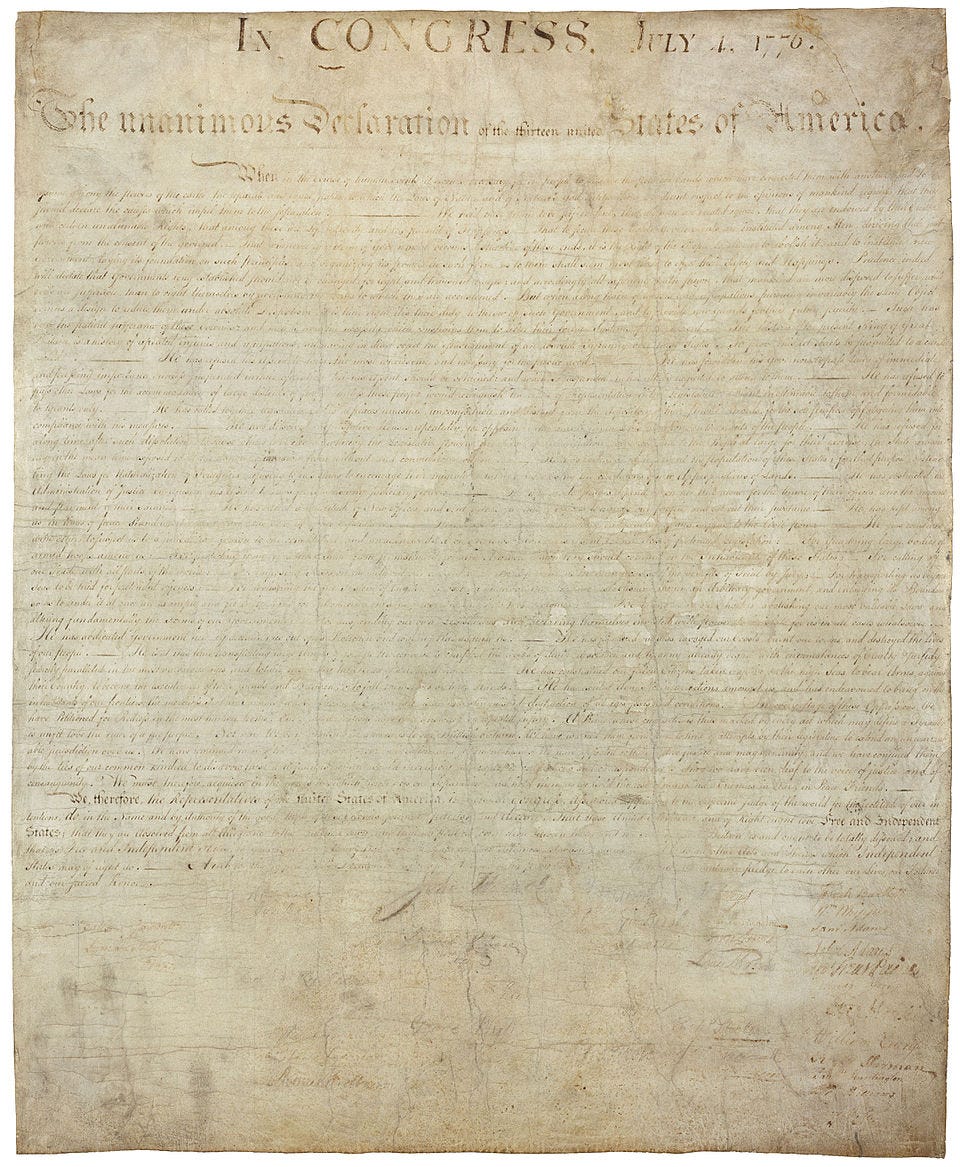
"It was passed verbally, and the copies contained only names of the president of Congress, John Hancock, and the secretary, Charles Thomson." Franklin pointed to the inkwell. "Signatures are more binding than words. More than half our congressmen are lawyers, and many are businessmen or merchants. They understand this.
"We must prove to the King that his colonies have not only declared independence," Franklin wove his fingers together as Nakomtha had, "but that we have become one nation of separate but equal states. Without it we are susceptible to British influence—each colony and each man could be pitted against the other to remain loyal to the Crown."
"The few men who voted against separation, like me," Dickinson said without a hint of apology, "will resign from Congress. Even I will admit unanimity is the strongest defense when we are already at war."
War. There it was, Nathaniel conceded.
"Consequently, two weeks ago, a resolution was passed to draft a formal parchment to be signed by a unanimous Congress. Here, on August second." Franklin held up his index finger. "One document. One set of signatures. A unanimous Declaration of these united states."
"Where do I come into all this?" Nathaniel asked.
Franklin knocked his walking stick against the leg of an empty chair. "Six men are unable to come—scattered from Virginia to Connecticut. A few of them are occupied by war efforts. Two are kept away by illness. One of them has not been heard from in weeks. August second is two days hence."
"Until we… you… gather the remaining signatures," Jefferson inhaled a breath, "neither the fifty-five men, nor the thirteen states are bound to one another. We are not one without you."
Nathaniel didn't know what to say. He knew the rebellion was about leaving the Empire, but he hadn't thought beyond that, as to what bound the colonies, the people, together in the fight. He looked away from the three men's expectant faces toward a large map of the colonies hanging on the wall near the assembly room door. Why would they choose just one man to cross all that land? Why him?
Nathaniel asked as much, knowing Franklin had personally inspected over sixteen hundred miles of America's post roads—copies of a few of Franklin's maps had helped him chart his own postal routes. Of all the men in Congress, surely Franklin knew the safest routes for such a document to take. "I would have thought it natural for you to use the Post for such a task."
"Switching horses and riders every ten or fifteen miles?" Franklin scoffed. "Each time the Declaration is handed off it will increase the likelihood of errors. Interceptions. The damn horses might begin to talk. The British might suspect, or even know, who we are, but our signatures are absolute proof of our treason."
"If the British find the Declaration first," Dickinson's face was grave, "they will prevent us from uniting the best way they know how. They will hang the signers… and those associated with carrying it."
Nathaniel turned cold.
Franklin raised a reassuring hand. "Only the three of us will know what you do. Congress has agreed that we are the sole members of a secret Carrying Committee."
"In a week's time, I leave to join the troops in New York," Dickinson said. "I will report on our whereabouts. We cannot have the Declaration riding through the middle of a battlefield."
"Myself and Mr. Jefferson will remain in Congress to communicate with you. So, there you have it." Franklin thumped his stick once more. "The job is yours, if you choose to accept it."
The three men faced Nathaniel, their shoulders set and their minds clearly made up. Nathaniel drew in a long breath. Then a word of Franklin's stood out starkly from the rest. He let out his breath in one swift burst and asked, "Job? Will I be paid?"
"Yes, handsomely," Franklin said. He blinked only once then said, "Thirty thousand pounds."
Nathaniel's breath caught in his throat.
"Doctor Franklin!" Dickinson pushed away from the table so hard it slid back several inches.
Jefferson gasped audibly and then he laughed. "Congress has not agreed to this—"
"Fifty-five lives will rest in his hands! That's five hundred pounds per man!" Franklin's face flushed as he stood again. "Less if you include all the men already fighting for the Cause. We three alone could pay the entire amount if Congress refuses."
"We have already agreed to commit our fortunes," Jefferson said.
"We agreed to commit our fortunes because we have them. He has none!" Franklin turned to Nathaniel. "Great rewards are given for great risk, Mr. Marten. We'll pay a portion to begin—funds enough to complete the task. The rest upon delivery. I will pay you myself if Congress cannot be persuaded. However, this reward does mean one thing: you must be willing to risk everything for it."
"Everything?" Nathaniel whispered, but he knew Franklin was right. He had nothing. No wealth. No property other than Bayard and the rifle over his shoulder, and no prospects beyond the gun shop. What did he have to risk, beyond his own life?
"There are only two things in this world for which we should risk everything, Mr. Marten. This is one of them," Jefferson said. If the Declaration was one, what was the other, Nathaniel wondered, but the question slipped from his mind when Franklin spoke again.
"If you have nothing to risk and everything to gain, you have nothing to lose." Franklin snapped his chin down like an exclamation mark at the end of one of his maxims.
Everything to gain. The words sank into Nathaniel and he thought back on the arguments between his father and Peter about the gun shop. The money Franklin was offering would be enough to prevent his father from having to produce weapons for the militia. The three blacksmiths could stay no matter how many clients died or joined the war. But was carrying this document just another short-term gain his father had warned them against?
Nathaniel rubbed a hand at the tension building in the back of his neck. "I… Even I am not certain I am the right man to carry a declaration of war."
"It is not a declaration of war. This is both a divorce decree and a binding marriage contract," Jefferson corrected him, and then he held fast to Nathaniel's gaze. "Moreover, it is an assertion of our commitment to uphold basic human rights. Including your freedom from tyranny. Surely you can appreciate that, Mr. Marten."
The tick-tock of a distant clock filled the air between them.
Nathaniel shifted uncomfortably. A simple delivery. To six men. Thirty-thousand pounds. If he could avoid a noose. He could hear his father's voice in his head whispering that only a fool would take such risks. The image of his mother's tears mingled with the yearnings of Kalawi's Wolf Clan. What of his own desire to remain neutral?
If he said yes, he would know the price of his convictions. If he said no, he would learn what they were worth. Nathaniel felt as though it was not just the three men in the room awaiting his answer, but all his loved ones and the whole of the colonies.
Franklin stood, breaking the silence. "It is wise for you to think this over, Mr. Marten. Congress had no fewer than fifty conversations to reach our agreement." He asked where Nathaniel would be staying and exacted a promise of confidentiality. When the information was given, Franklin added, "We will be right here in these chambers the morning of August second, awaiting your answer. At the very least, we trust you will find us. Or we will come looking for you."
"Yes, sirs." Nathaniel swallowed thickly. "Understood." He bid the men goodnight and walked stiffly toward the door, feeling as though he were dragging a massive weight from the room. He crossed the threshold into the quiet hall, pausing just outside the assembly room door. He turned to look once more at the carved face of the woman. Though she still gazed upon him with vacant eyes, now her high brow seemed afflicted with an uncertainty equal to his own. Nathaniel's doubt doubled when he heard Jefferson's words fall into the hall.
"I hope we have selected wisely, gentlemen. If he says yes, Nathaniel Marten will be the one carrying independence for us all."
Join us next week to meet a new face—one Silas Hastings—a man of questionable character in time of unrest.
Join the Conversation
How would you weigh the potential for great reward against risks that could cost you everything?
This chapter is part of "Carrying Independence," a historical novel following the journey of the Declaration of Independence as Nathaniel, a reluctant Post rider, gathered the signatures needed to unite America. If you're enjoying Nathaniel's story and don't want to wait for the next installment, autographed copies of the complete novel are available here.